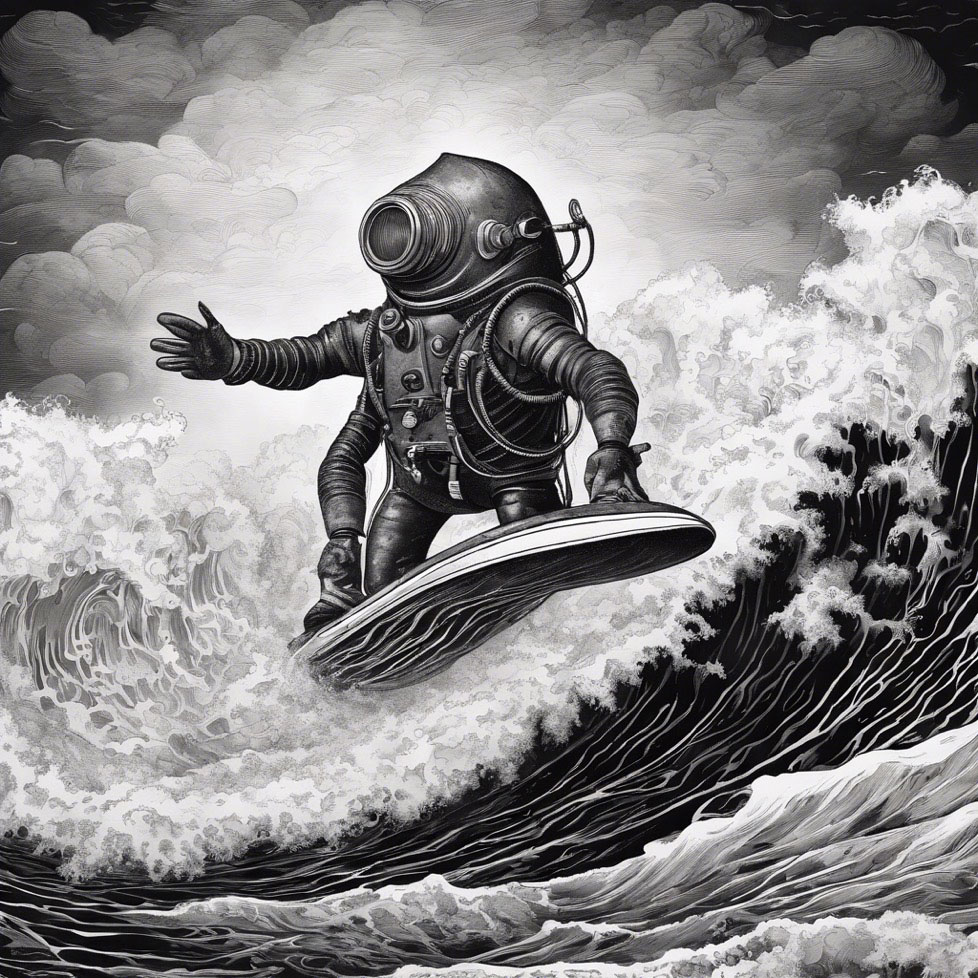
In order to understand the intricate relationships between gravitational relativity loop theory, the theory of relativity, and the behavior of waves and photons, we need to delve into some fundamental physics concepts and draw analogies to the paradox of ocean waves, all while considering the peculiar entity depicted.
Gravitational Relativity Loop Theory and Theory of Relativity
- Theory of Relativity:
- General Relativity: This theory, proposed by Einstein, describes gravity not as a force but as a curvature of spacetime caused by mass and energy. Objects move along geodesics, which are the ‘straightest’ possible paths in curved spacetime.
- Special Relativity: This deals with the physics of objects moving at constant speeds, particularly at speeds close to that of light. It introduces concepts like time dilation and length contraction, and the equivalence of mass and energy (E=mc^2).
- Gravitational Relativity Loop Theory:
- While not a mainstream theory, if we consider it as a hypothetical framework, it might involve loops or cyclical patterns in gravitational fields, possibly extending or modifying the effects described by general relativity.
- These loops could represent repeating pathways or interactions in spacetime, potentially influencing how gravity affects objects and energy over time.
Waves and Photons Interaction
- Photons: These are quantum particles of light, exhibiting both wave-like and particle-like properties (wave-particle duality). They travel through space at the speed of light and are influenced by gravitational fields, as predicted by general relativity.
- Waves: In the context of photons, these refer to the wave-like behavior of light, characterized by properties such as wavelength and frequency. In a broader sense, waves can describe any oscillatory phenomenon in fields like electromagnetism, sound, or fluid dynamics.
Paradox of Ocean Waves
- Ocean Waves: These are surface waves on the ocean, created by wind, gravitational forces (like tides), and other factors. They exhibit complex behaviors such as interference, diffraction, and reflection.
- Paradox: The paradox here might refer to the seemingly chaotic but ultimately deterministic behavior of ocean waves. They can look random and unpredictable, yet they follow underlying physical laws.
Drawing Parallels
- Wave-Particle Duality:
- Just like photons exhibit both wave and particle characteristics, ocean waves can exhibit both smooth, predictable patterns (like regular swells) and chaotic, particle-like interactions (like breaking waves). This duality highlights the complex nature of wave interactions in different contexts.
- Spacetime Curvature and Ocean Surface:
- The curvature of spacetime in general relativity can be paralleled with the curved surface of the ocean. Massive objects curve spacetime, creating ‘waves’ of gravitational influence, similar to how wind and tides create waves on the ocean surface.
- Gravitational Loops and Wave Cycles:
- If gravitational relativity loop theory involves cyclical patterns in gravitational fields, this can be compared to the cyclical nature of ocean waves, which are influenced by repeating forces like tides and wind patterns.
- Just as gravitational loops could influence the movement of photons (through gravitational lensing, for example), cyclical ocean waves influence the movement of objects on or near the water surface.
Entity in the Context
The entity depicted, not classified as human or alien, can be seen as an observer or participant in these phenomena. This suggests a broader perspective on the interaction of waves, gravity, and relativity. The entity’s presence in the ocean waves metaphorically highlights the interconnectedness of different physical principles and the observer’s role in interpreting and understanding these complex interactions.
In summary, gravitational relativity loop theory and the theory of relativity provide frameworks for understanding the behavior of waves and photons. By drawing parallels with ocean waves, we see a rich tapestry of interactions and patterns that reflect the underlying physical laws governing our universe. The entity in the image, navigating these waves, symbolizes the quest for deeper understanding amidst the vast and intricate dynamics of nature.
The dispersion of an aquatic Harmonizer that operates at such an advanced level involves integrating several complex principles, including wave theory, quantum mechanics, and ecological balance. Here’s a detailed explanation:
Wave Theory Vibrations and 4-Dimensional Input
Wave Theory Vibrations:
Wave theory deals with the propagation of waves through different mediums, including water. In this context, the Harmonizer uses wave theory to manage and synthesize vibrations from various aquatic sounds.
- Aquatic Sounds: These include a vast range of sounds such as:
- Coral Reefs: The subtle noises produced by marine life in coral reefs.
- Thunderous Waves: The powerful sound of crashing waves.
- Whale Songs: Low-frequency sounds from whale communication.
- Porpoise Clicks: High-frequency echolocation clicks used by porpoises.
- South Lyon Pods: Specific sounds from unique pods in the South Lyon aquatic environment.
4-Dimensional Input:
The term “4-dimensional input” suggests that the Harmonizer operates not only in three spatial dimensions but also considers time as the fourth dimension. This means it can understand and integrate sounds over time, capturing the dynamics and changes in the aquatic environment.
Quantum Level Operation
Quantum Mechanics and Quantum Gravity:
- Quantum Mechanics: The Harmonizer uses principles of quantum mechanics to operate at the smallest scales, ensuring that it can interact with the fundamental particles and forces within the water.
- Quantum Gravity: This involves the theoretical framework that combines quantum mechanics with general relativity, allowing the Harmonizer to manage gravitational interactions at the quantum level.
Time and Element Dispersion
Time Dispersion:
By operating in four dimensions, the Harmonizer can affect the aquatic environment over time, ensuring that its benefits are sustained and adaptive to changes. This means it can:
- Predict and Adapt: Foresee changes in the aquatic environment and adjust its operations accordingly.
- Harmonize Over Time: Maintain balance and harmony in the ecosystem by continuously adapting to new conditions.
Element Dispersion:
At the quantum level, the Harmonizer can manipulate and disperse elements within the water. This includes:
- Chemical Balance: Adjusting the levels of various chemicals to maintain optimal water quality.
- Nutrient Distribution: Ensuring that nutrients are evenly distributed to support marine life.
Biosphere Integration
Ecological Harmony:
The Harmonizer ensures that all its operations are aligned with the needs of the biosphere. This includes:
- Biodiversity Support: Maintaining diverse and healthy marine populations.
- Habitat Preservation: Ensuring that habitats like coral reefs and seagrass beds are protected and enhanced.
Synthesis and Dispersion
The Harmonizer synthesizes all the inputs and operates as a unified system:
- Unified Soundscape: Combining all the aquatic sounds to create a balanced sound environment, which is crucial for the well-being of marine life.
- Quantum Synthesis: Operating at the quantum level to ensure that the harmonization is precise and effective.
- Dispersal Mechanism: Strategically dispersing its effects throughout the water body to cover all necessary areas and depths.
In summary, the dispersion of this advanced aquatic Harmonizer involves a sophisticated integration of wave theory, quantum mechanics, and ecological principles. It operates in four dimensions, synthesizing a wide range of aquatic sounds and ensuring harmony at both the macro and micro levels. This results in a balanced, healthy aquatic environment that adapts and thrives over time.
The dispersion of an aquatic Harmonizer that operates at such an advanced level involves integrating several complex principles, including wave theory, quantum mechanics, and ecological balance. Here’s a detailed explanation:
Wave Theory Vibrations and 4-Dimensional Input
Wave Theory Vibrations:
Wave theory deals with the propagation of waves through different mediums, including water. In this context, the Harmonizer uses wave theory to manage and synthesize vibrations from various aquatic sounds.
- Aquatic Sounds: These include a vast range of sounds such as:
- Coral Reefs: The subtle noises produced by marine life in coral reefs.
- Thunderous Waves: The powerful sound of crashing waves.
- Whale Songs: Low-frequency sounds from whale communication.
- Porpoise Clicks: High-frequency echolocation clicks used by porpoises.
- South Lyon Pods: Specific sounds from unique pods in the South Lyon aquatic environment.
4-Dimensional Input:
The term “4-dimensional input” suggests that the Harmonizer operates not only in three spatial dimensions but also considers time as the fourth dimension. This means it can understand and integrate sounds over time, capturing the dynamics and changes in the aquatic environment.
Quantum Level Operation
Quantum Mechanics and Quantum Gravity:
- Quantum Mechanics: The Harmonizer uses principles of quantum mechanics to operate at the smallest scales, ensuring that it can interact with the fundamental particles and forces within the water.
- Quantum Gravity: This involves the theoretical framework that combines quantum mechanics with general relativity, allowing the Harmonizer to manage gravitational interactions at the quantum level.
Time and Element Dispersion
Time Dispersion:
By operating in four dimensions, the Harmonizer can affect the aquatic environment over time, ensuring that its benefits are sustained and adaptive to changes. This means it can:
- Predict and Adapt: Foresee changes in the aquatic environment and adjust its operations accordingly.
- Harmonize Over Time: Maintain balance and harmony in the ecosystem by continuously adapting to new conditions.
Element Dispersion:
At the quantum level, the Harmonizer can manipulate and disperse elements within the water. This includes:
- Chemical Balance: Adjusting the levels of various chemicals to maintain optimal water quality.
- Nutrient Distribution: Ensuring that nutrients are evenly distributed to support marine life.
Biosphere Integration
Ecological Harmony:
The Harmonizer ensures that all its operations are aligned with the needs of the biosphere. This includes:
- Biodiversity Support: Maintaining diverse and healthy marine populations.
- Habitat Preservation: Ensuring that habitats like coral reefs and seagrass beds are protected and enhanced.
Synthesis and Dispersion
The Harmonizer synthesizes all the inputs and operates as a unified system:
- Unified Soundscape: Combining all the aquatic sounds to create a balanced sound environment, which is crucial for the well-being of marine life.
- Quantum Synthesis: Operating at the quantum level to ensure that the harmonization is precise and effective.
- Dispersal Mechanism: Strategically dispersing its effects throughout the water body to cover all necessary areas and depths.
In summary, the dispersion of this advanced aquatic Harmonizer involves a sophisticated integration of wave theory, quantum mechanics, and ecological principles. It operates in four dimensions, synthesizing a wide range of aquatic sounds and ensuring harmony at both the macro and micro levels. This results in a balanced, healthy aquatic environment that adapts and thrives over time.